
Blogs


It is important to have an A Level GP essay that is structurally sound and riddled with high-quality content. As a continuation of the article on approaching essays at the A Levels, this one, brought to you by the top JC tuition in Singapore, aims to go in-depth into the intricacies of how you can go about analyzing an A Level GP essay.
There are two main essay structures tested at the A Level GP examinations.
In essence, an A Level GP essay asks for either an opposing refutation or opposing limitation. To understand what refutation or limitation essays look like, refer to the explanation below.
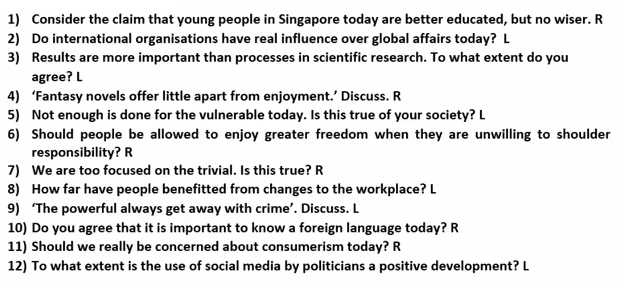
With R and L referring to refutation and limitation question types respectively, we can become more adept at identifying them from Fig 1.
Generally, refutation structures are used when the question poses a general statement.
For instance:
All of these prompt the writer to disagree with the given stand. Therefore, a refutation structure would be most suitable.
On the other hand, limitation structures arise when the question contains absolute or sweeping statements.
For example:
These questions require you to discuss the degree to which the statement is valid.
For limitation questions, you cannot purely disagree with the given stand. Instead, you must demonstrate the extent to which your disagreement applies.
Limitations
(Questions asking for a degree of agreement)
Refutations
(Questions presenting general statements)
To dive deeper, we have chosen two example questions to analyse further.
Question: Should people be allowed to enjoy greater freedom when they are unwilling to shoulder responsibility?
This is a refutation question.
Part A: Supporting the Stand
Explain why people should still be allowed to enjoy greater freedom even if they are unwilling to bear responsibilities for their actions.
Part B: Refuting the Stand
Show why it is not reasonable to allow people who shirk responsibilities to enjoy greater freedom. Part B contradicts Part A and aims to challenge the claims made earlier.
Question: Do international organisations have real influence over global affairs today?
This is a limitation question.
You cannot argue that international organisations have no influence at all. Instead, you must examine the degree of influence they possess.
Part A: Supporting the Claim
While international organisations may appear to influence global affairs...
Part B: Showing the Limitations
In reality, the limitations they face constrain their ability to exert real influence.
Additionally, students should include examples relevant to the local context if a question includes the phrase “in your society.”
Being able to identify keywords in an A Level GP essay question is a crucial skill that our JC GP tuition programme constantly emphasises.
Keywords help determine the structure of your essay and define the boundaries of what you can write.
Question: Should people be allowed to enjoy greater freedom when they are unwilling to shoulder responsibility?
Should: Consider the desirability, obligation, or wisdom of granting greater freedom to this group.
Greater freedom: Refers to the growing number of liberties people enjoy today and the stronger protection of these freedoms.
Shoulder responsibilities: Being prepared to account for the consequences of one’s actions. In this question, the individuals described are unwilling to do so.
Question: Do international organisations have real influence over global affairs today?
International organisations Organisations with international membership, scope, or presence.
These may include International Governmental Organisations (IGOs) such as:
They may also include International Non-Governmental Organisations (INGOs) or NGOs such as:
Real: Actual, significant, or tangible influence.
Influence: The power to alter or affect outcomes.
Global affairs: Major political, economic, or social events that concern multiple countries.
Now that we know how to analyse the question, we can move on to writing strong body paragraphs.
A strong paragraph should contain:
Point Liberal democracies view freedom as a constitutional right that cannot easily be revoked by human laws.
Explanation Freedom is often seen as a natural right of every individual. Making freedom conditional can be seen as a violation of human dignity.
For example, the abolition of slavery demonstrates society’s belief that people are born free and should remain free.
Example:
The Second Amendment of the United States Constitution protects the right to bear arms. Many American citizens argue that this right allows individuals to take responsibility for their own security.
Point If people refuse to take responsibility, there is no obligation to grant them greater freedom.
Explanation People live within a social contract where individuals agree to follow laws so that society can function safely.
Example:
Freedom of speech should not extend to offensive or discriminatory remarks.
In Singapore, issues relating to race, religion, and vulnerable communities such as the elderly, LGBT individuals, and foreign domestic workers are particularly sensitive. Words have real consequences, and responsible speech is essential.
Point and Explanation International organisations often have significant resources due to their large memberships. These resources include funding, manpower, and supplies, which allow them to influence global events.
Example:
During the 2009 financial crisis, the IMF, EU, and European Central Bank provided bailout packages totalling 289 billion euros to rescue Greece. This intervention prevented Greece from leaving the Eurozone and stabilised the region’s economy.
Point and Explanation
The influence of international organisations depends heavily on whether sovereign states are willing to cooperate with them. Countries still prioritise their national interests and may reject external intervention.
Example:
China rejected the Hague Tribunal’s 2016 ruling on the South China Sea dispute and continued its land reclamation activities despite international criticism.
A strong GP essay follows a clear and structured process:
Following this systematic approach will help you write clearer and stronger A Level GP essays.
Mastering A Level GP essays requires more than just memorising examples. Students need to learn how to analyse questions, identify keywords, structure arguments, and support their ideas with strong explanations and relevant examples.
At Zenith Education Studio, our GP tuition programme helps students develop these essential skills through a structured and proven approach. Lessons focus on:
Our experienced GP tutors guide students step-by-step so they can approach A Level GP essays with greater clarity and confidence.
If you would like to experience our teaching approach, you can sign up for a free trial lesson to see how our lessons help students improve their essay writing and analytical skills.
You may also explore our testimonials page to hear from students who have benefited from our JC GP tuition programme.
Explore resources and strategies for learners at every stage




.avif)